


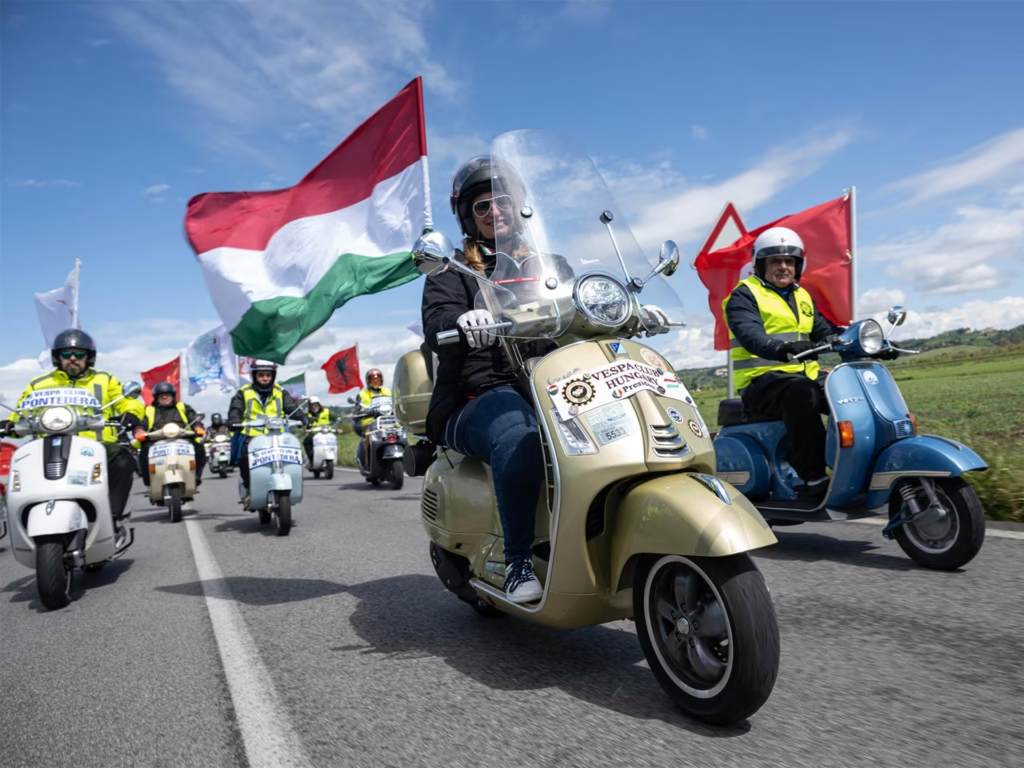
For four days this summer, Rome sounded a little different.
Vespa 80th anniversary, Rome 2026.
The familiar noise of the Italian capital was joined by thousands of Vespa engines as riders from around the world arrived to celebrate one of Italy’s most recognisable creations.
From June 25 to 28, the Eternal City hosted Vespa Roma 2026 – 80 Years of an Icon, marking eight decades since the first Vespa appeared in 1946. More than 50,000 visitors attended the celebrations, turning Rome into the centre of the global Vespa community.
The biggest spectacle came on Saturday, June 27, when the Vespa Parade moved through the streets of Rome and passed one of the city’s ultimate landmarks: the Colosseum.
It was an appropriately cinematic setting for a machine that has spent much of the past 80 years representing an idealised version of Italian life.
From Post-War Transport to Italian Icon
The Vespa story began in 1946, when Italy was emerging from the devastation of the Second World War.
Piaggio, which had previously manufactured aircraft, needed to reinvent its business. Italy, meanwhile, needed inexpensive and practical transportation.
The answer was a small scooter unlike the motorcycles of the period.
The Vespa was relatively easy to ride, offered protection from dirt and road spray, and had a distinctive steel body. Even its name became part of the legend: “Vespa” means “wasp” in Italian.
What began as a practical mobility solution quickly became something much bigger.
Over its 80-year history, Vespa has sold nearly 20 million scooters. More than two million of those were sold during the past decade alone, and the brand is now present in around 100 countries.
When Hollywood Discovered Vespa
Few vehicles are as closely connected with a city as Vespa is with Rome.
One reason is cinema.
The defining moment came in the 1953 film Roman Holiday, starring Audrey Hepburn and Gregory Peck. Hepburn’s Princess Ann explores Rome on the back of a Vespa, creating images that would become inseparable from both the scooter and the city.
Vespa was no longer simply transportation. It represented freedom, youth, romance and the apparently effortless elegance of Italian life.
The scooter would subsequently appear across films, advertising, fashion and popular culture.
More than seven decades later, riding a Vespa past the Colosseum still evokes much of the same imagery.
That made Rome the natural choice for Vespa’s biggest birthday celebration.
Rome Becomes the World’s Vespa Capital
The four-day anniversary event was centred around the Foro Italico and Stadio dei Marmi, with a dedicated Vespa Village bringing together historic machines, current models, exhibitions, competitions and riders from around the world.
The programme went well beyond a conventional motorcycle gathering.
There was a World Gymkhana Championship testing riders’ agility and control, a European Vespa Rally Championship, live music, exhibitions and activities dedicated to the international network of Vespa Clubs.
On Sunday, the celebrations concluded with a Concorso di Eleganza, putting the emphasis back on something that has always separated Vespa from ordinary transportation: style.
That distinction helps explain why the Vespa community remains unusually international.
People do not necessarily buy an 80-year-old design because it is the most rational way to get from A to B. They buy into the history and identity surrounding it.
A New Vespa Built to Celebrate 1946
Piaggio also used the anniversary to introduce one of the rarest modern Vespas.
The Vespa Edizione Ottantesimo was unveiled at the Foro Italico on the opening day of the celebrations.
Based on the Vespa GTS 310, only 1,946 numbered examples will be produced. The number is, of course, a reference to the year the first Vespa was created.
Its design deliberately connects the modern scooter with its industrial origins.
The bodywork takes inspiration from raw steel, while green details reference colours associated with early Vespa production. Even the wheels reinterpret the enclosed pressed-steel design used on the original Vespa 98.
Underneath the retro references, however, it is very much a modern machine.
Its 310cc engine produces 25 hp, making it the most powerful engine fitted to a Vespa. It also comes with LED lighting, a five-inch TFT display, keyless ignition, ABS, traction control and smartphone connectivity.
It is a neat summary of what Vespa has spent decades trying to achieve: modernise the technology without losing the silhouette that makes the scooter instantly recognisable.
Why Has Vespa Survived for 80 Years?
Perhaps the most interesting part of Vespa’s anniversary is not that the company can organise a huge gathering in Rome.
It is that people still care enough to come.
The automotive and motorcycle industries are filled with once-famous names that disappeared or became almost unrecognisable over the decades. Vespa has instead managed to continuously update essentially the same idea.
There have been around 160 updates and versions during the scooter’s history, while production today takes place in Italy, India and Vietnam.
Yet put a 2026 Vespa next to one from the 1950s and the family resemblance is immediately obvious.
That consistency has allowed Vespa to become more than a scooter brand.
It has become shorthand for a particular image of Italy: narrow streets, cafés, summer evenings, elegant clothes and the freedom to move through a city on two wheels.
La Dolce Vita, 80 Years Later
Rome has changed enormously since Audrey Hepburn climbed onto a Vespa in Roman Holiday. Transportation has changed even more.
Cars became ubiquitous, motorcycles became faster, cities built metro systems, electric scooters appeared on pavements and the mobility industry entered the age of apps and electrification.
And yet the Vespa remains.
The 2026 celebrations demonstrated just how powerful that continuity can be. More than 50,000 people came to Rome not merely to look at an old Italian scooter, but to celebrate a design and lifestyle that has survived eight decades.
For a few days, thousands of Vespas once again filled the streets of the Eternal City.
And 80 years after the first one appeared, the little Italian scooter still looked completely at home.