


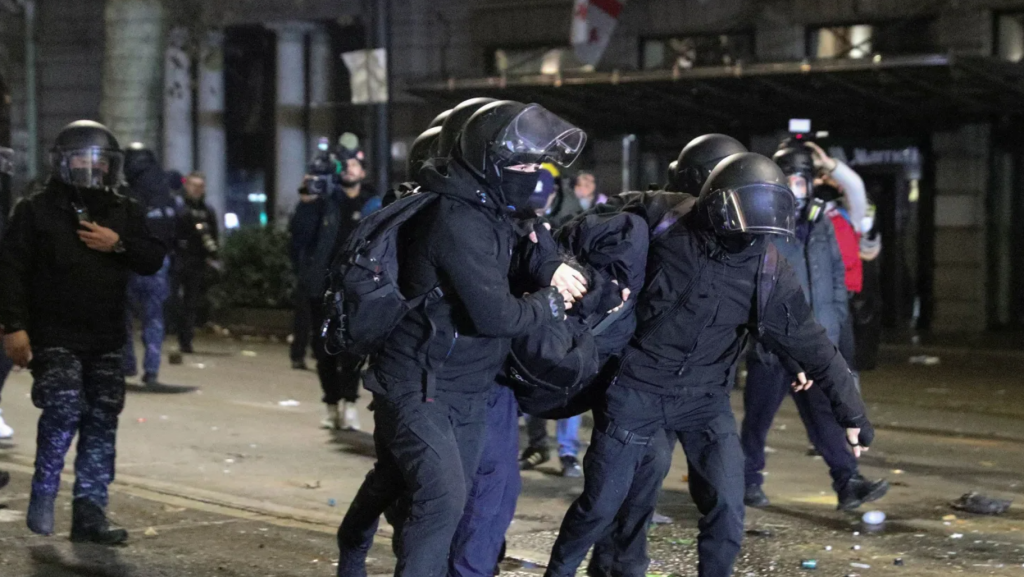
A third consecutive night of protests in Georgia’s capital, Tbilisi, against the government’s decision to suspend negotiations to join the European Union, resulted in 44 people being hospitalized, according to officials on Sunday.
On Saturday night, tens of thousands of demonstrators gathered outside the parliament, hurling stones and setting off fireworks. In response, police deployed water cannons and tear gas. Protesters burned an effigy of Bidzina Ivanishvili, the billionaire founder of the ruling Georgian Dream party, who is often criticized for his ties to Russia.
The Interior Ministry reported that 27 protesters, 16 police officers, and one media worker required hospitalization.
Government Response
Prime Minister Irakli Kobakhidze warned of strict enforcement against lawbreakers.
“Any violation of the law will be met with the full rigor of the law,” he stated during a briefing on Sunday, adding that political leaders inciting violence would also face consequences.
Kobakhidze refuted claims that Georgia’s EU integration had been abandoned.
“The only thing we have rejected is the shameful and offensive blackmail, which was, in fact, a significant obstacle to our country’s European integration,” he said.
The announcement followed the European Parliament’s resolution criticizing Georgia’s recent general election, which it deemed neither free nor fair.
The Prime Minister also dismissed the U.S. State Department’s decision to suspend its strategic partnership with Georgia. The Department condemned the government’s move away from EU accession, but Kobakhidze attributed the criticism to the outgoing U.S. administration, stating:
“This will not have any fundamental significance. We will wait for the new administration and discuss everything with them.”
EU and International Concerns
In a joint statement, EU foreign policy chief Kaja Kallas and enlargement commissioner Marta Kos expressed deep concern over Georgia’s decision to pause EU negotiations.
“This marks a departure from the European aspirations of the vast majority of Georgian people, as enshrined in the Constitution of Georgia,” the statement read.
The EU reiterated its worries about democratic backsliding in the country and called on Georgian authorities to respect the rights to freedom of assembly and expression while refraining from force against peaceful protesters, politicians, and journalists.
Disputed Elections and Rising Tensions
The Georgian Dream party’s controversial victory in the October 26 parliamentary election, perceived as a referendum on Georgia’s EU ambitions, has fueled mass demonstrations and prompted the opposition to boycott parliament. Critics allege that the election was rigged with Russian involvement, aimed at maintaining Georgia within Moscow’s sphere of influence.
Pro-Western President Salome Zourabichvili criticized the government, calling Georgia a “quasi-Russian” state.
“We are not demanding a revolution. We are asking for new elections, but under conditions that ensure the will of the people is not misrepresented or stolen again,” Zourabichvili said.
EU Membership in Jeopardy
Georgia was granted EU candidate status in December 2023, contingent upon fulfilling key reforms. However, the EU has put accession on hold and reduced financial aid following the government’s passage of a “foreign influence” law, which critics say undermines democratic freedoms.
The situation underscores deep divisions within Georgia over its future—between a pro-European path and pressures from Russia. As protests continue, the standoff between the government and its people raises questions about the nation’s democratic trajectory and international alliances.
Source: CNBC