

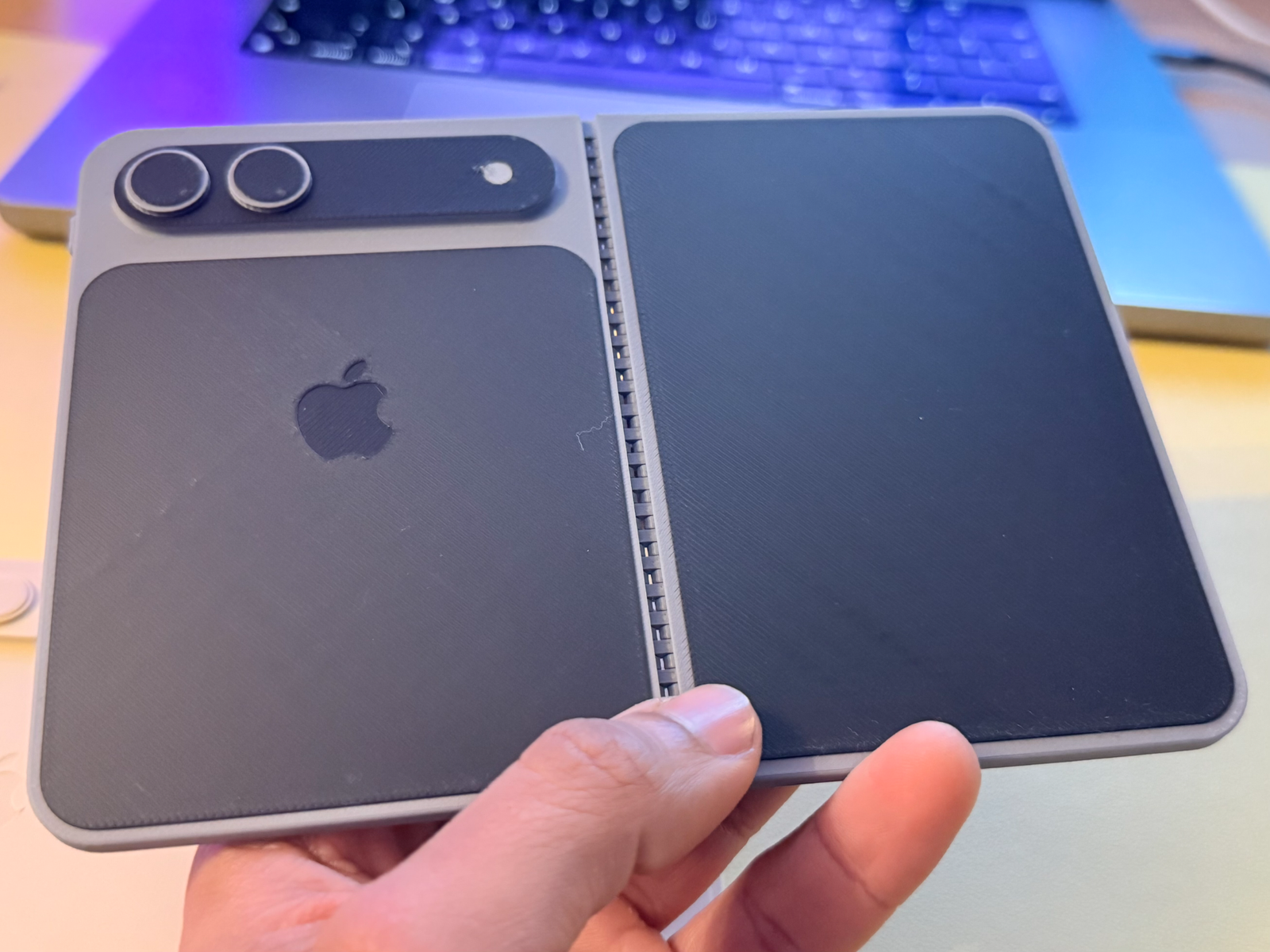
Apple’s long-rumored foldable iPhone may finally arrive next year, and a newly surfaced physical dummy offers the clearest hint yet of what the device could look like. While foldable phones are no longer a novelty, Apple appears ready to challenge existing design conventions with a form factor that prioritizes the unfolded experience over the closed one.
If the model reflects Apple’s current thinking, the iPhone Fold could feel less like a phone that opens up and more like a compact tablet that folds down.
A physical model based on leaked CAD files
The dummy surfaced on MakerWorld, where a user known as Subsy shared a 3D-printed plastic model reportedly based on leaked CAD files from Apple’s production pipeline. Although the creator does not claim the model represents a final retail unit – its hinge design, for example, does not follow any confirmed Apple patent — it serves as a realistic reference that can be held and examined.
Unlike digital renders, this physical model highlights proportions and ergonomics that are harder to judge on screen. Those proportions suggest Apple is experimenting with a noticeably different approach to foldable hardware.
A square design inspired by the iPad mini
According to the dummy, Apple has optimized the iPhone Fold for use when fully opened. In that state, its aspect ratio closely resembles that of an iPad mini rather than a stretched smartphone display. As a result, the device looks significantly squarer when folded than a traditional iPhone.
This decision marks a clear departure from most Android foldables. Devices from companies like Samsung and Google typically rely on tall, narrow outer displays so they feel like regular phones when closed. Apple’s concept instead embraces a wider internal screen, potentially offering a more comfortable layout for reading, multitasking, and media consumption.
A wider canvas than current foldables
Because of its squarer geometry, the iPhone Fold’s internal display could feel more cinematic and less constrained than competing foldables. For users, that may translate into fewer compromises when switching between phone and tablet modes. Apps designed for larger screens could benefit immediately, especially productivity tools, games, and video platforms.
At the same time, the compact folded shape could challenge expectations. It may feel unfamiliar in a pocket compared to today’s slim smartphones, yet that trade-off could pay off once the device unfolds.
What Apple might reveal at WWDC
Developers may not have to wait until launch day to understand how Apple plans to support this new form factor. WWDC in early to mid-June 2026 could offer early clues, even if Apple avoids directly mentioning a foldable iPhone.
Apple could introduce new interface guidelines or APIs that help apps adapt more fluidly to changing screen sizes and orientations. In the past, the company has quietly prepared developers for upcoming hardware shifts well before announcing new devices. If history repeats itself, WWDC may hint at the software foundation behind the iPhone Fold.
A different direction for Apple’s next iPhone
If the leaked dummy proves accurate, the iPhone Fold will not simply follow the path set by existing foldable phones. Instead, Apple seems to be rethinking what a folding iPhone should be, starting with how it feels when fully open rather than how it looks when closed.
While many details remain unconfirmed, one thing is clear: Apple’s foldable ambitions appear far more radical than incremental. And if the company delivers on this vision, the iPhone Fold could redefine expectations for foldable smartphones when it finally arrives.
