

Few innovations have changed modern football as dramatically, or generated as much debate, as the Video Assistant Referee.
Better known as VAR, the system was introduced with a straightforward goal: help referees correct major mistakes in match-changing situations. In practice, it has transformed how goals, penalties, red cards and offsides are judged, while creating an entirely new part of the matchday experience.
A goal goes in. Players celebrate. Supporters erupt. Then someone notices the referee touching an earpiece.
Suddenly, everyone waits.
For some fans, VAR makes football fairer by catching mistakes that could decide championships, relegation battles or knockout matches. For others, lengthy reviews and extremely tight offside decisions have taken spontaneity away from the sport.
So what exactly is VAR, how does it work, and where is the technology heading?
What is VAR and How Does It Work?
VAR stands for Video Assistant Referee. It is not simply a computer making refereeing decisions. The VAR is a qualified match official who has access to video footage and communicates with the referee on the pitch.
VAR was formally incorporated into football’s Laws of the Game from the 2018/19 edition and has since been adopted by major competitions around the world.
Under the current VAR protocol, video officials can intervene in specific match-changing situations, including:
- Goal or no-goal decisions
- Penalty or no-penalty decisions
- Red-card incidents
- Cases of mistaken identity
- Certain additional situations permitted under the latest VAR protocol, including clearly incorrect corner decisions where competitions adopt the option and the error can be corrected immediately
The basic principle remains that the referee makes the initial decision on the field. VAR then checks relevant incidents using available camera angles.
Importantly, VAR is not supposed to re-referee every challenge or questionable decision. For many subjective incidents, intervention is intended for a “clear and obvious error” or a serious missed incident.
What happens during a VAR check?
The process usually begins behind the scenes.
Video officials continuously monitor the match from a video operation room. If a potentially reviewable incident occurs, they examine the available footage.
Sometimes the VAR can establish a factual point, such as whether a player was offside or whether an offence occurred inside or outside the penalty area.
More subjective incidents can result in an on-field review.
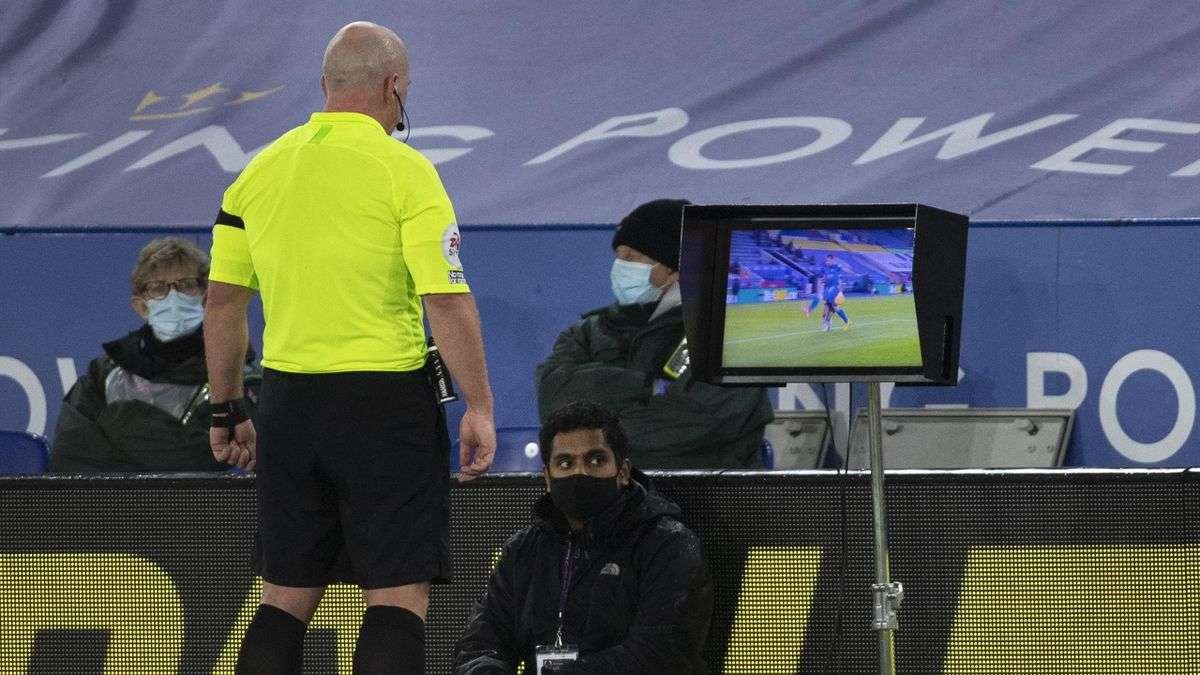
This is when the referee walks to the pitchside monitor and watches replays before making a final decision. Despite the name “Video Assistant Referee”, the VAR does not replace the match referee. The final decision remains with the referee.
There is also no fixed maximum time for a review under the VAR protocol. Accuracy is considered more important than speed, although football authorities have increasingly focused on reducing unnecessary delays.
How does VAR decide offside?
Offside decisions have become one of the most recognisable uses of VAR.
Early implementations relied heavily on officials selecting frames and positioning virtual lines to determine whether an attacker was ahead of the relevant defender.
Technology has continued to evolve.
The Premier League, for example, introduced Semi-Automated Offside Technology (SAOT) in April 2025. The system uses optical player tracking and multiple cameras to automate important elements of the offside process.
Instead of requiring officials to manually construct every element of a close offside decision, the technology can suggest the relevant kick point and automatically generate offside lines. A VAR still reviews and approves the result.
It is therefore “semi-automated” rather than fully automated.
The objective is straightforward: make close offside decisions faster and more consistent without removing human oversight.
Impact of VAR on Match Outcomes
The biggest argument in favour of VAR is also the simplest: it can correct important refereeing mistakes.
Before video assistance, a referee or assistant referee could make a split-second mistake that directly decided a match. Television viewers might see the error immediately from multiple angles, but officials had no mechanism to reverse it.
VAR changed that.
A missed handball before a goal, a foul inside the penalty area or a player incorrectly judged onside can now be reviewed before the match continues.
There is evidence that this improves the overall accuracy of major decisions.
According to Premier League figures for the 2024/25 season, match officials initially got 86% of key match incidents correct. After VAR intervention, the accuracy rate increased to 97%.
That difference can be enormous over an entire season.
A single penalty can change a match. A single match can affect European qualification or relegation. In a knockout competition, one incorrect decision can end a team’s tournament immediately.
VAR therefore provides officials with a second opportunity to examine the incidents carrying the greatest consequences.
If VAR produces more accurate decisions, why does it remain so controversial?
The answer is that football decisions are not always binary.
Technology can provide another camera angle, slow down footage or determine a player’s position with remarkable precision. But it cannot remove interpretation from the Laws of the Game.
The “clear and obvious” problem
One of the most common arguments concerns the threshold for intervention.
If a referee’s original decision is subjective, how wrong does it need to be before VAR becomes involved?
Two experienced officials can watch the same tackle and reach different conclusions about its intensity. The same applies to handball decisions, physical contact inside the penalty area and potential red cards.
VAR may provide better evidence, but a human still has to interpret it.
This can create frustration when apparently similar incidents produce different outcomes.
Offside by tiny margins
Offside has generated a different controversy.
Unlike many fouls, offside is largely factual: a player is either in an offside position or is not.
But VAR made it possible to examine extremely small margins that would have been almost impossible for an assistant referee to identify in real time.
Goals being disallowed because an attacker appeared marginally ahead of a defender led some supporters to question whether technology was following the spirit of the offside law.
Semi-automated systems are designed to make these decisions faster and more consistent, but they do not eliminate the philosophical debate over how precise football should become.
Delays and interrupted celebrations
Another major criticism is time.
Football is built around continuous play, and lengthy reviews can disrupt its rhythm.
A 30-second check may feel insignificant on paper. Inside a stadium after a potentially decisive goal, it can feel much longer.
Technology is already helping reduce those delays. The Premier League reported that VAR delays fell from an average of 64 seconds to 39 seconds per match in 2024/25. Semi-automated offside technology also helped save time on offside checks after its introduction.
The challenge is finding the right balance between getting decisions right and allowing the game to flow.
Is slow motion always fair?
Slow-motion footage is another point of debate.
A challenge viewed at normal speed may look like a natural football action. Viewed repeatedly in slow motion, the same contact can appear far more dramatic.
Officials therefore have to consider not only what happened but also the context, speed and intensity of an incident.
More video does not automatically mean an easier decision.
Sometimes it simply provides more information to interpret.
The Future of VAR in Football
VAR is unlikely to disappear from elite football.
Instead, the technology is moving into its next phase: faster decisions, greater automation and better communication with supporters.
Semi-automated offside technology is one of the clearest examples.
In the Premier League, the system uses up to 30 cameras around a stadium, with several recording at 100 frames per second. It can track the ball and thousands of data points across players’ bodies to help establish close offside decisions.
The technology then generates visualisations that can be shown to broadcasters and supporters.
But even sophisticated systems still leave humans involved. The VAR must confirm that the technology has identified the correct players and relevant moment, while subjective offside situations can still require interpretation.
That model may provide a clue to VAR’s future.
Rather than replacing referees, technology is increasingly likely to handle factual or measurable elements while humans concentrate on subjective decisions.
More transparency for fans
Communication could be just as important as technology.
One of the strongest complaints about VAR has been that supporters do not always understand what is happening during a review.
Experiments and competitions using referee announcements provide a possible solution. Instead of simply displaying “VAR CHECK” on a screen, officials can explain the outcome of a review to spectators.
That could make controversial decisions easier to understand, even when fans disagree with them.
VAR itself is still evolving
The rules surrounding VAR are not fixed forever.
For the 2026/27 Laws of the Game, The IFAB approved further adjustments to situations where VAR assistance can be used, including certain clearly incorrect second-yellow-card situations and, as a competition option, clearly incorrectly awarded corners where the mistake can be corrected immediately without delaying the restart.
The IFAB has also acknowledged the value of reviewing the VAR system after roughly a decade of development to identify ways of improving its efficiency and fairness.
That suggests the VAR of the future may operate differently from the system football fans first encountered in 2018.
Has VAR Made Football Better?
There may never be a universal answer.
VAR has made it possible to correct major errors that previously would have remained part of the result forever. It has improved the accuracy of important decisions and given referees access to information their predecessors could only have dreamed of having.
At the same time, it has introduced new problems.
Fans debate intervention thresholds. Goals can be followed by uncomfortable pauses. Offside decisions can depend on extraordinarily fine margins. And even after watching an incident from five different camera angles, referees, players, pundits and supporters can still disagree.
That reveals perhaps the most important thing to understand about VAR.
Technology can provide better evidence, but it cannot make football completely objective.
The next stage of VAR is therefore unlikely to be about adding more video screens. It will be about making decisions faster, using automation where it genuinely helps and communicating the process more clearly to the people watching.
VAR was created to remove obvious mistakes from football. Its biggest challenge now is doing so without removing the speed, emotion and spontaneity that make the sport worth watching.
