The World’s Working-Age Population Is Peaking – in Three Powerful Waves
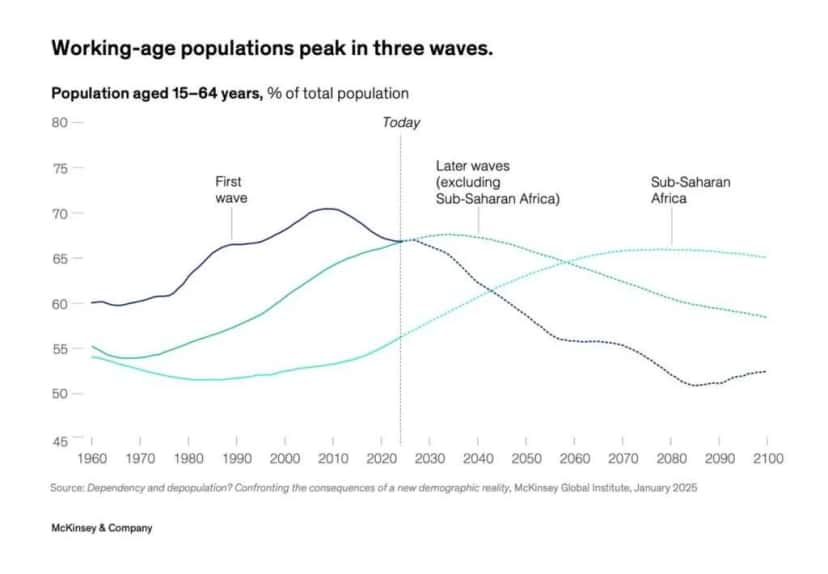
For decades, global growth relied on a growing workforce. More people of working age meant higher output, stronger consumption, and expanding tax bases. That model is now changing. The share of people aged 15–64 is peaking – not everywhere at once, but in three distinct demographic waves that will reshape economies through the rest of

For decades, global growth relied on a growing workforce. More people of working age meant higher output, stronger consumption, and expanding tax bases. That model is now changing. The share of people aged 15–64 is peaking – not everywhere at once, but in three distinct demographic waves that will reshape economies through the rest of the century.
A recent analysis by McKinsey Global Institute shows how this shift unfolds across regions from 1960 to 2100. The message is clear: the world is entering an era of demographic divergence.
Why the Working-Age Population Matters
The working-age population forms the backbone of every economy. It fuels:
- Economic growth
- Tax revenues
- Pension and healthcare systems
- Innovation and entrepreneurship
When this group grows faster than dependents, countries benefit from a demographic dividend. When it shrinks, growth slows and fiscal pressure rises.
Wave One: Advanced Economies Have Already Turned
The first wave hit advanced economies and East Asia, including Western Europe, Japan, South Korea, and China.
From the 1960s to the early 2000s, falling fertility and rising life expectancy pushed the working-age share toward historic highs, often near 70% of total population. However, by the 2010s, the trend reversed.
Today, these economies face:
- Fewer young workers
- Rapid population aging
- Rising pension and healthcare costs
As a result, growth now depends far more on productivity gains than on labor expansion.
Wave Two: Emerging Markets Are Reaching Their Peak
The second wave includes Latin America, Southeast Asia, the Middle East, and parts of South Asia.
These regions entered their demographic sweet spot later, as fertility declined more gradually. Many will see their working-age population peak during the 2030s.
This phase creates a narrow opportunity. Countries that invest in education, infrastructure, and job creation can still lock in long-term growth. Those that fail risk stagnation once the demographic tailwind fades.
Wave Three: Sub-Saharan Africa’s Historic Rise
The third wave belongs almost entirely to Sub-Saharan Africa.
Unlike other regions, Africa has not yet peaked. Its working-age population share will continue to rise well into the second half of the century. By 2100, the region could account for more than 40% of global workforce growth.
This shift positions Africa as the future center of global labor supply — and potentially of consumption and innovation.
However, demographics alone do not guarantee success. Without large-scale job creation and investment, rising youth populations could amplify unemployment and migration pressures instead of prosperity.
What This Means for the Global Economy
As workforces shrink in aging regions, several consequences follow:
- Slower growth: Fewer workers cap GDP expansion unless productivity rises
- Labor shortages: Healthcare, construction, and technology already feel the strain
- Fiscal stress: Smaller tax bases must support growing elderly populations
In response, countries increasingly turn to automation, AI, later retirement, and migration to stabilize growth.
Migration and Technology Take Center Stage
Demographic gaps between regions will reshape migration flows. Aging economies will compete for younger workers, while labor-rich regions will seek opportunity abroad.
At the same time, technology acts as a force multiplier. AI and automation help offset shrinking workforces by raising output per worker. In many advanced economies, technology now functions as a partial substitute for population growth.
The Age of Demographic Divergence
The global workforce no longer moves in one direction. Some regions age rapidly, while others still expand. These diverging paths will influence investment, geopolitics, and economic power for decades.
The era of growth driven by population expansion is ending. The next chapter will depend on productivity, policy choices, and how effectively societies invest in people.