
Election Day 2026 Is Tomorrow: What U.S. Voters Should Check
Election Day is November 3. Check your polling place, registration, identification rules and state ballot deadlines through official election offices.
The next regularly scheduled federal general election is Tuesday, November 3, 2026, according to the Federal Election Commission. With Election Day one day away, voters across the United States need to check the rules that apply where they live rather than rely on a national deadline or a polling location used in a previous election.
The practical questions are local: where to go, when the polls open and close, what identification is required and how an outstanding mail ballot must be returned. The FEC directs voters to state and local election offices for those answers because election administration is primarily governed by state law.
A national election date does not mean a single set of voting procedures. Official government links are the starting point for checking an individual situation, particularly after a move or a change in registration information.
Start with your registration and polling place
USAGov directs voters to the National Association of Secretaries of State’s Can I Vote service, where selecting a state leads to that state’s election website. Its registration guidance says voters can check their name, address and polling place through the relevant state system.
The agency also explains that a registration can be marked inactive. An inactive record may require additional steps before voting, and a provisional ballot may be necessary if those steps have not been taken.
Checking a record now does not guarantee that a state will still allow a registration change before Tuesday. Registration deadlines vary, and USAGov notes that some fall as much as 30 days before an election. Questions about a missing or incorrect record therefore belong with the election office responsible for it.
Confirm identification and ballot-return rules
USAGov says each state sets its own voter identification requirements. Most require identification for in-person voting, but a document accepted in one state should not be assumed acceptable in another.
Mail-ballot deadlines also require care. Pennsylvania’s election calendar lists 8 p.m. on November 3 as the deadline for county election offices to receive completed mail-in and civilian absentee ballots. That is a receipt deadline, so simply putting an envelope in the mail is a different action from having it reach the office.
Washington’s calendar, meanwhile, says voters can deposit a ballot in an official drop box by 8 p.m. on Election Day. It also lists November 3 as the deadline for in-person voter registration or updates. These examples illustrate why voters should consult their own state’s instructions rather than apply a rule reported about another state.
Use official information for the final check
USAGov’s Election Day page links to polling-place information, identification requirements and sample ballots. Sample ballots can help voters review the candidates and state or local questions before arriving at a voting location.
The same page states that voting online is not available in U.S. federal elections. An online registration lookup or an online ballot-information page is not the same thing as casting a ballot.
Before leaving home or returning a ballot, confirm the location, hours and applicable instructions with the relevant state or local election office. This article describes official resources and selected state examples; it does not establish an individual voter’s eligibility or replace the instructions issued by that voter’s election officials.
Sources
- https://www.fec.gov/introduction-campaign-finance/election-results-and-voting-information/
- https://www.usa.gov/confirm-voter-registration
- https://www.usa.gov/election-day
- https://www.sos.wa.gov/elections/elections-calendar/dates-and-deadlines
- https://www.pa.gov/agencies/vote/elections/upcoming-elections
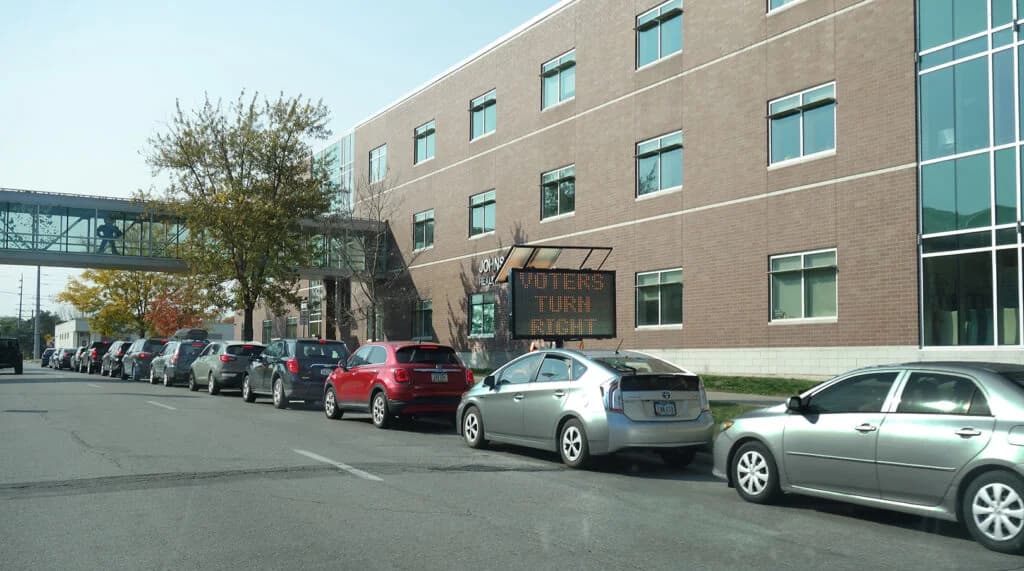
Featured image: An early-voting vehicle queue in Iowa City, Iowa, in October 2020; archival photograph used for illustration. Photo: Alan Light / Wikimedia Commons, CC BY 2.0. Original photograph, unaltered.
